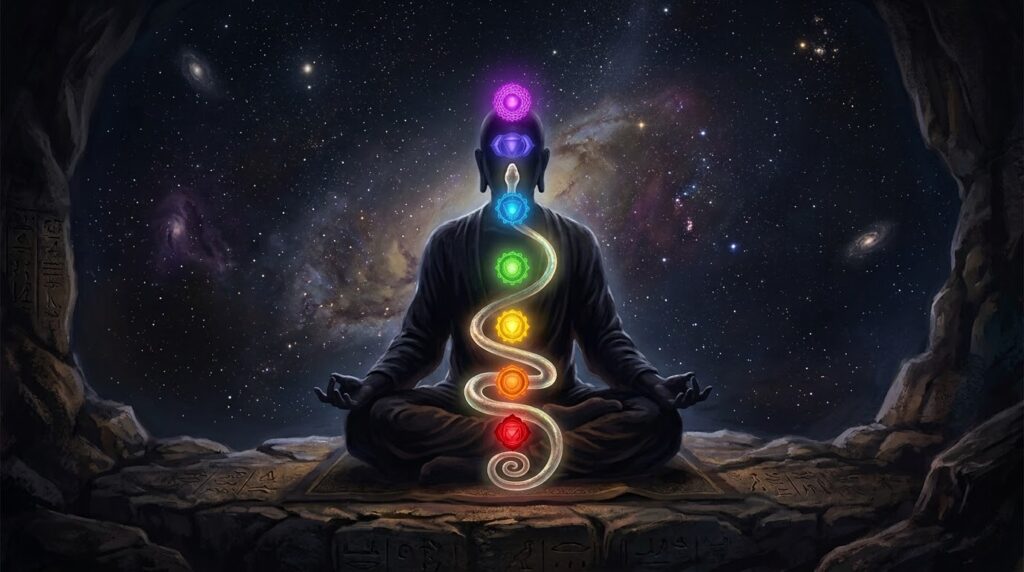
So according to the ancient science of Yoga, there is a path to self-discovery through the manipulation of the sleeping serpent, the kundalini, which rests at the base of the spine, the lowest of the seven chakras. The number seven itself has an interesting history — the classical Sanskrit text most often credited with this framework, the Shat-Chakra-Nirupana, actually describes six centers (its name literally means “description of the six centers”), with the crown, or sahasrara, originally treated separately as a non-local point of consciousness rather than a numbered chakra. Traditions vary even further: Buddhist texts often describe five chakras, while Hindu sources describe six or seven. The seven-chakra system most of us know today took its familiar shape after Sir John Woodroffe’s 1919 translation, The Serpent Power, introduced it to the West, later reinterpreted through Carl Jung’s 1932 lectures on the subject. My simplistic breakdown of the chakras below follows that familiar seven, by number, with a brief description of each.
One – the root of life. one exists in space and time. In Sanskrit, the root chakra is called muladhara — mula meaning “root,” adhara meaning “support” or “foundation” — and it governs the most basic instincts: survival, safety, and a sense of belonging. Modern psychological readings of the chakras, most notably Anodea Judith’s Eastern Body, Western Mind, map this root center onto infancy, echoing Erik Erikson’s “trust versus mistrust” stage of early development — the literal root of a person’s basic sense that the world is safe. Skeptics note that the chakras’ claims about a physical subtle-energy body haven’t been scientifically verified, and are better understood as a symbolic map of human experience than an anatomical one — but as a metaphor for the work of feeling grounded and secure, it’s hard to beat.
Two – procreation. One exists to produce offspring. In Sanskrit, this chakra is svadhisthana — “one’s own dwelling place,” or the seat of the self. It governs the water element: fluid, adaptable, and tied to pleasure, emotion, and creative expression as much as to reproduction. Procreation is the most literal reading of this center, but classically it’s really the chakra of creation itself — the drive not just to make offspring, but to make anything: art, ideas, connection, feeling.
Three – appetite. It starts with food, but it includes all material possessions. In Sanskrit, this center is manipura — “city of jewels,” from mani (gem) and pura (city) — governed by the fire element. It’s the seat of willpower, self-esteem, and personal power, and just as it digests food, it digests experience itself: turning raw appetite into ego, ambition, and the drive to acquire, possess, and control. Classical descriptions center more on confidence and self-worth than material acquisition specifically — extending it to “all material possessions” is my own reading of what that ego-driven appetite looks like in practice.
Four – love. The heart is the dynamo for the entire system. One can finally start living outside his or her own needs. Empathy, relationships of a pure and natural desire… In Sanskrit, this center is anahata — “unstruck,” the sound made without two things colliding — a pure note untouched by conflict or contact. It sits literally at the midpoint of the seven chakras, the bridge between the three lower centers of material survival and the three upper centers of spiritual awareness, governed by the air element. That’s why it works as the “dynamo” of the whole system: everything below it feeds up, everything above it flows down, and all of it passes through the heart.
Five – voice. The word is God, God is the word. One can create his own reality that is infused with God’s love, his protection, and his direction, through study of the sacred texts and listening to Nature’s voice, eventually understanding that the Creator spoke the universe into existence. In Sanskrit, this center is vishuddha — “especially pure,” or purification — governed by akasha, the ether or space element, and considered the seat of sacred sound, or shabda. The parallel I am drawing here isn’t unique to one tradition: Hindu cosmology holds that the universe began with sound, embodied in the syllable Om, while Christian mysticism describes creation as beginning with the Word — two traditions independently landing on sound and voice as the mechanism of creation itself.
Six – control. The pineal gland in the brain has been actively suppressed by all modern civilizations. It is the chakra of mental dominance, control of others. This power can be misused and much havoc results. But billionaires don’t have this strength, because none of them have gotten past appetite. Saruman, from Lord of the Rings, or Franklin Graham would be examples of control gone bad. When control is used correctly, you have all the prophets, holy men and sages throughout history. In the political realm, think Marcus Aurelius, Ashoka the Great, St. Francis of Assisi, Andrew Carnegie, FDR, maybe JFK. Carnegie is the exception that proves the rule: after building one of the largest fortunes in American history, he gave away roughly ninety percent of it before he died, arguing in his own writing that dying rich was itself a disgrace — a billionaire who broke past appetite rather than staying stuck in it. St. Francis belongs on this list for more than his holiness: within a decade of founding the Franciscan order in 1209, it had grown to more than five thousand friars spread across Europe, with papal backing from Innocent III — control exercised not through armies or wealth, but through the deliberate construction of an institution that would outlast him by centuries. Marcus Aurelius and Ashoka reached this chakra through restraint, developing a moral system for themselves and others.
When a good person stops his quest before reaching transcendence, he has chosen to remain in the world, and thus will be recycled like everyone and everything else. In Sanskrit, this center is ajna, “order or command,” traditionally linked to the pineal gland and known as the third eye. The Western philosophical tradition backs this up more directly than you’d expect: Descartes called the pineal gland the “principal seat of the soul,” the one place in the brain, as he saw it, where mind and body actually met. Worth knowing as the more skeptical read: mainstream science attributes pineal gland calcification mainly to normal aging, but many have argued against the use of fluoride in toothpaste.
Seven – transcendence. The crown of consciousness is on top of the brain, at the very tip of the sushumna — the central channel that, in kundalini tradition, runs from the base of the spine up to the crown, carrying the awakened serpent energy along its length. If the kundalini reaches the crown while the mind and the body are in good condition, something marvelous happens. One receives a direct connection to source, the Creator of the Universe. A purple light of pure and clear consciousness travels that distance instantly. In Sanskrit, this center is sahasrara, “thousand-petaled” — not a literal count, but a symbol of consciousness without limit. It’s described as the point where individual awareness dissolves into the universal, and nearly every source agrees on its color: violet or white, which lines up neatly with the purple light I am describing here. It’s also, fittingly, where the whole piece comes full circle — this is the “seventh” chakra that isn’t quite one of the original six, the non-local point layered on top of the classical system.
Acolytes, be aware that since the sixties, the modern world has tried to close that corridor with satellites and massive electronic noise. The demiurge of the world has managed to retain almost all human spirit within this prison planet. It’s devious and hard to combat. I have developed methods to boost my signal, but that is an essay for another day.
The term “demiurge” has real philosophical lineage worth knowing: it comes from Plato’s Timaeus, where it originally meant “craftsman” and described a benevolent creator shaping the cosmos out of existing chaos. Gnostic writers of the second century inverted that entirely, recasting the demiurge as an ignorant or malevolent lesser god who traps human souls inside a false material world — the “prison” framing here comes directly from that tradition, most vividly in texts like the Secret Book of John.
For many, many people the sleeping serpent never awakens. Even sleeping, though, it can still influence the three lowest chakras. We are alive, we have a desire for sex, and we have so many appetites.