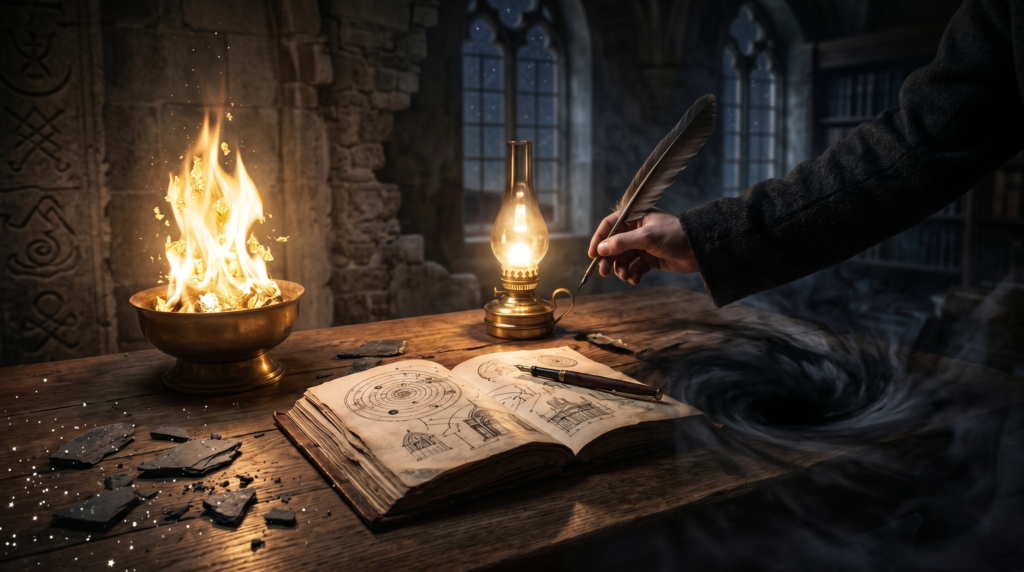
For many creators, the act of expression feels less like a choice and more like a compulsion—a fire that burns with relentless intensity, pushing boundaries and birthing ideas at breakneck speed. Yet, this high-octane state often carries a hidden cost. When the flame burns too hot, the inevitable cooling can feel like a plunge into an abyss of exhaustion and shadow. Understanding this cycle is not just about managing a diagnosis; it is about learning how to honor the creative fire without letting it consume the hearth that sustains us.
The “Fire” of Manic Creativity
In the throes of a manic or hypomanic episode, the world often shifts into high definition. Ideas arrive not in a trickle, but in a torrent; the brain feels capable of making connections that are invisible in slower moments. This “creative fire” provides an intoxicating sense of agency, making it feel as though the work is being dictated by some higher, limitless energy.
The Sensory Experience of the Fire
- Hyper-connectivity: The sudden, overwhelming realization of how seemingly unrelated concepts intersect.
- Time Dilation: Hours pass in what feels like minutes, yet productivity feels doubled or tripled.
- Radiant Confidence: A profound, often unshakeable belief that the current project is a masterpiece in the making.
The “Abyss” (The Crash)
The transition from the fire to the abyss is often jarring. When the manic surge dissipates, the silence that follows can feel heavy, even suffocating. It is during this “shadow” phase that the brilliance of the earlier work may feel distant, or even alien, leading to deep exhaustion and a sense of detachment from one’s own creative impulses. Yet, this phase is not a failure; it is a necessary, if painful, aspect of the rhythm of the human psyche.
“The shadow is not an enemy to be defeated, but a part of the self to be integrated. In the cooling of the fire, we find the stillness necessary to synthesize what we have created, transforming the raw output of the mania into the enduring work of the soul.”
The challenge lies in cultivating sustainable rhythms rather than living in the extremes. By recognizing the early flickers of the “Fire” and the subtle onset of the “Abyss,” creators can begin to build guardrails—simple, grounding routines—that allow for high-level output without the eventual burnout. It is a process of learning to act as both the architect and the gardener of one’s own mind.
The goal is not to extinguish the creative flame, nor is it to permanently dwell in the shadows of the abyss. It is to find the middle ground where both can exist in balance.
What rituals or “anchors” do you use to keep your footing when you feel your creative energy shifting toward an extreme? Do you view your shadow self as a hindrance to your work, or as a necessary partner in the creative process? Let us know your thoughts in the comments below.