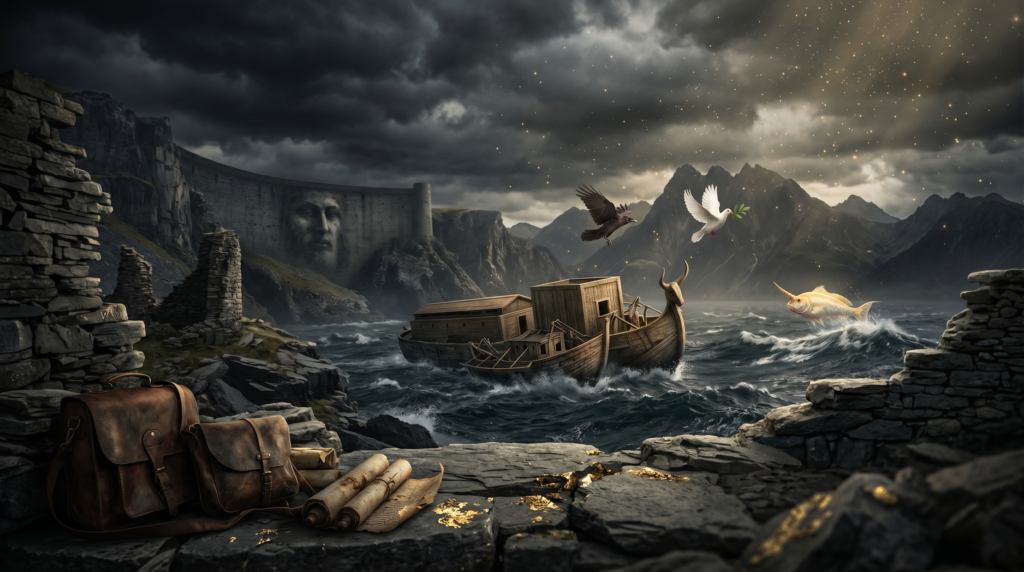
Throughout human history, very few stories have echoed as persistently across diverse civilizations as the account of a great, world-cleansing flood. While separated by geography and millennia, cultures ranging from the ancient Near East to the Indian subcontinent share a strikingly similar core narrative: a divine warning, a chosen hero, a vessel for survival, and the eventual rebirth of the world. By examining these accounts, we uncover not just ancient folklore, but perhaps a shared human memory of catastrophe and hope.

The Epic of Gilgamesh (Utnapishtim)

The Shatapatha Brahmana (Manu)

The Book of Genesis (Noah)
The Epic of Gilgamesh
In the Mesopotamian epic, the gods decide to destroy humanity with a deluge, but Enki, the god of wisdom, secretly warns Utnapishtim. He is instructed to dismantle his house to build a massive, cubical boat, loading it with his family, gold, and “the seed of all living creatures.” After six days of relentless rain, the boat lands on Mount Nimush, and Utnapishtim releases a dove, a swallow, and a raven to find dry land.
The Shatapatha Brahmana
In this Hindu tradition, Manu is washing his hands when a small fish asks for protection from larger predators. As the fish grows, it warns Manu of an impending flood that will carry away all creatures. Manu builds a ship as instructed. When the flood arrives, he ties the ship to the horn of the fish (who is an avatar of Vishnu/Brahma), which steers him to safety on the Northern Mountains.
The Book of Genesis
In the Hebrew tradition, God finds the world corrupt and decrees a flood to wipe away life. He charges the righteous Noah with building an ark of gopher wood. Noah brings his family and pairs of every kind of animal into the ark. After the waters recede, the ark comes to rest on the mountains of Ararat. Noah then releases a raven and a dove to signal that the earth is once again habitable.
| Feature | Utnapishtim (Mesopotamia) | Manu (Hinduism) | Noah (Hebrew) |
| Divine Cause | The gods decided to destroy humanity due to noise/unruliness. | Universal dissolution (Pralaya) at the end of an age. | Human corruption and wickedness. |
| Divine Warning | Enki (God of Wisdom) whispers to a wall. | Matsya (The Fish avatar of Vishnu). | God speaks directly to Noah. |
| Vessel Type | A massive, multi-story cube. | A ship or ark. | A rectangular ark of gopher wood. |
| The Testing Birds | Dove, Swallow, Raven. | Not explicitly mentioned (often symbolic). | Raven, Dove. |
| Outcome | Granted immortality by the gods. | Becomes the progenitor of the new human race. | Blessed and commanded to repopulate the earth. |
Whether these stories share a common historical root in an ancient geological event or represent a universal archetypal fear of nature’s power, they serve a singular purpose: they remind us that even in the face of absolute destruction, there is a path toward preservation and new beginnings.
What do you think these echoes across distant cultures suggest about our shared history? Do you see these narratives as historical records, or as symbolic warnings meant for all generations? Let us know your thoughts in the comments below.
Shared stories like this, mirrored by disparate groups, are surely the basis for Jung’s archetypes.
The cross-cultural flood narrative embodies Jung’s concept of the collective unconscious by mapping the psychological journey of death, rebirth, and inner transformation. In this framework, the deluge represents water as the chaotic, overwhelming unconscious mind breaking through to submerge the conscious ego. To survive this mental cataclysm, the Hero archetype builds an ark—a protective container of consciousness—preserving the core elements of the self. This destructive apocalypse ultimately serves as a necessary cleansing process that mirrors individuation, allowing the old personality to dissolve so a renewed, fully integrated self can emerge from the receding waters of chaos.
Nice post.