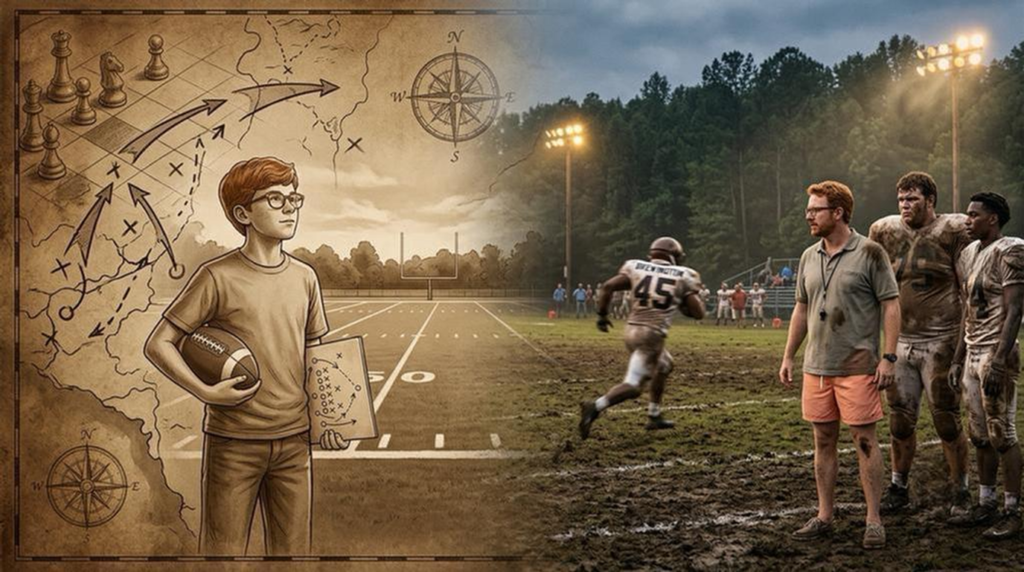
I was thirteen, small for my age, but built like a tight knot of wire. I knew exactly how smart I was, which meant I didn’t have the decency to hide it. While the other kids were memorizing standard plays, I’d already mapped out the histories of the Peloponnesian War, analyzed Bobby Fischer’s chess openings, and memorized whole passages of Sun Tzu. To me, the Pop Warner field wasn’t just a game; it was a campaign.
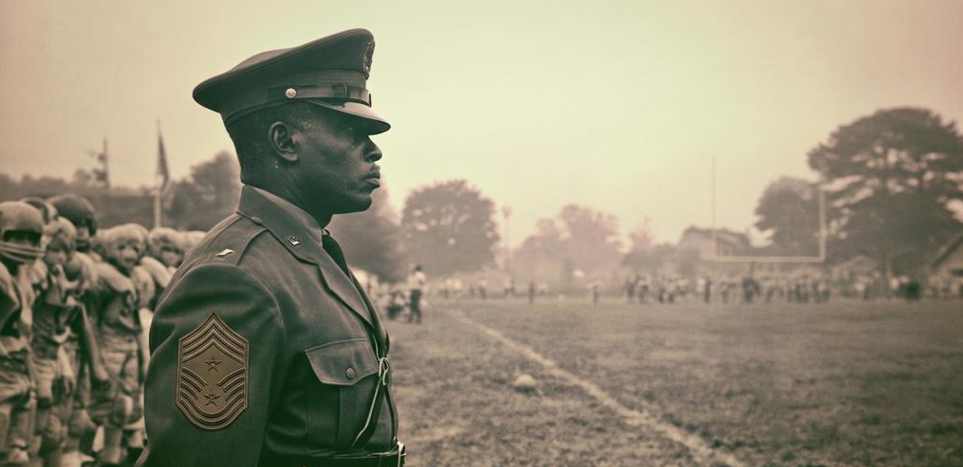
Across the gridiron, the opposing coach stood like a monument to humorless authority. He wore his crisp, official uniform, his eyes locked onto the field with absolute command. Beside him stood his son—six foot one of pure varsity-level muscle, moving with a synchronized, clockwork precision that proved he was less of a player and more of a well-drilled soldier.
We are early in the game, and I can see how the other team is overplaying the sweep. Their defense is shifting like clockwork, completely predictable. I jog over to the sidelines, my chest out.
“Hey, Coach,” I say, breathing hard but keeping my voice steady. “They’re biting on the sweep every single time. It’s an over-commitment. Standard Sun Tzu—they’re rushing where they think we’re weak, leaving their flank wide open.”
The coach looks down at me, squinting. “Just run the play called, kid.”
“Listen to me,” I press on, already drawing in the dirt with my finger. “We run a quick pitch to the right, fake the sweep, but we have a reverse coming back left. The secondary will be fifty yards out of position before they even realize the ball changed hands. It’s a textbook counter-maneuver.”
He grunts, looks at the field, then back at me. “Fine. Try it. If it blows up, it’s your head.”
The play runs. Quick pitch by me, the defense surges right like a herd of cattle, and our star athlete takes the reverse all the way down the left sideline for a touchdown. As we trot back, I deliberately walk past the opposing coach—the uptight Command Chief Master Sergeant with the fifteen stripes on his sleeve, looking like he just swallowed a pinecone.
“Hey Sergeant!” I yell over the crowd, flashing a grin. “Might want to check your perimeter! You’ve got a massive breach on the left flank!”
My next play is the kick off, and since I’m still tired, I trot down the field. I see him out of the corner of my eye a split second too late—the coach’s six-foot-one son, delivering a crushing, retributive blindside hit. I hit the turf hard, throwing my right arm back instinctively to break the fall. A sickening snap echoes in my ears.
My brain goes into a strange, detached sort of triage. I hop right back up, cradling the deformed, dangling forearm with my left hand, and jog calmly over to the bench.
“Coach,” I say, presenting the arm like a broken piece of equipment. “I think I broke my arm.”
The coach’s eyes go wide as saucers, his face turning pale. “Jesus Christ, kid! Lay down! Don’t move! Don’t look at it! Someone call the base ambulance!”
“It’s a clean fracture of the radius and ulna, I think,” I say, entirely too detached for a thirteen-year-old. “But I can still walk.” I have always processed pain differently than most
“Get on the ground!” he screams, his voice cracking.
Because my father was owned by the Air Force, they hauled me over to the base hospital in a screeching olive-drab ambulance. By the time the Orthopedic Surgeon finally strutted into the ER, he looked like a man whose entire weekend had been personally ruined by the underclass. He didn’t look me in the eye. He just snapped his latex gloves with a sharp, echoing crack that sounded like another bone breaking, furious about losing his Saturday morning.
He tossed his clipboard onto a stainless steel tray with a loud clatter and addressed the corpsman standing next to him, loud enough for the entire ward to hear.
“Why do I have to waste my time worrying about the dog soldiers?” he barked. “An enlisted man’s kid snaps his arm on a weekend, and I’m supposed to drop everything? They are of absolutely no importance to the operational efficiency of the Air Force. None.”
When he finally deigned to look down at me, his eyes were as cold and sterile as the room. “You think the flight line stops because you want to play hero on a Pop Warner football field, boy? Hold still. This is going to hurt, and frankly, I don’t want to hear you whine.”
The “dog soldiers” he was dismissing so casually meant me, my dad, and every other non-commissioned officer and dependent on that base. It even included that diminutive Command Chief Master Sergeant on the opposing sidelines, regardless of how many stripes he wore.
I stared at the ceiling, biting my lip as he set the bones. I thought about calling him an arrogant prick. I thought about telling him exactly what he could do with his operational efficiency. But he was currently holding the violently broken bones of my arm—which I’d made significantly worse by jumping up and running to the sidelines—so I clamped my jaw shut.
So I didn’t say a word, but I always remembered that lesson. Regardless of who I am or what I know, there will always be a group of people who think that they are better than me. At the time, I considered it some kind of aberration because of the military, which is a very ordered society. Later, I learned that is how the broken world of man operates. Also, hearkening back to the original injury, I learned not to mock the powerful.
I carried that lesson with me for three decades. I learned that the military wasn’t the only place stratified by small men with small minds; unfortunately, the weak and useless were the norm.
Thirty years later, I found myself walking onto a different kind of battlefield as the assistant coach in charge of offense at a small junior high in East Rockingham, North Carolina. It was a closed cotton mill town, a place hollowed out by NAFTA, full of the kind of tough, left-behind kids the world considered “dog soldiers.”
On my first day of practice, the only gear I had to my name was a pair of ridiculous, peach-colored swim trunks. The head coach—a rigid man who also served as the school’s assistant principal—took one look at them and must have decided I was some kind of pansy. Wanting to test my mettle, he waited until I was standing near the fifty-yard line, turned to the team, and gave the order: Take him down.
I barely had time to brace myself before they started coming at me, charging one or two at a time. I met them with thirty years of built-up grit, throwing them around like Chinese matchsticks, cleats tearing up the grass. Then a big black player surged through, delivering a heavy, glancing blow—though I could tell his heart wasn’t truly in it, no real murder in his soul. But it was enough to stagger me. Off-balance and panting, I was easy pickings for a huge white boy who tracked me like a missile and leveled me into the dirt.
Knocked flat on my back, looking up at the North Carolina sky, I started to laugh. It probably wasn’t the head coach’s intention, but I loved the raw violence of it. In that dirt, an instant bonding occurred with my boys. The hierarchy was established. The question of who is alpha? had been answered, and the real work could begin.
By the end of the season, we had clawed our way to the final game—the infamous “Toilet Bowl,” a matchup pitting the two smallest, most overlooked teams in the league against each other. Our opponents were the Ellerbe Wildcats, a squad packed with cock-strong farmboys who hit like runaway trucks and never seemed to tire.
We fill out our side with tough, underfed boys living in the poor side of a small southern town. We didn’t have the luxury of deep benches or specialized squads. Almost all my boys had to play both ways, bleeding on offense and turning right around to hit on defense until their lungs burned.
But out of that lean, gritty roster, I had two absolute standouts who anchored the entire team.
First, there was Billy, a big white boy weighing in at around 240 pounds. If Billy was a Ford F-350 with dually wheels and a winch, built to plow through any obstacle by sheer force of will, then my other star, Nathan, was an old-model Cadillac. Nathan was black, about six feet tall and 220 pounds, all solid metal, buffed to absolute perfection, and as fast as a whisper. All season, I’d harbored grand coaching plans of turning Nathan into a tight end, but his hands just weren’t built for catching; instead, he found his true calling as an awesome, terrifying defensive end.
Knowing we were supposed to lose to Ellerbe, and realizing we had nothing left to hide, I decided during that final week of practice to mix things up. I broke the traditional coaching mold and did something radical for junior high football: I asked for real input from the players.
We huddled up, listened to what the boys saw on the field, and decided to put both of my heavy-hitter stars right in the backfield together. In the dirt of that practice field, we generated a few beautiful, chaotic trick plays.
When the whistle blew, the game instantly devolved into an old-fashioned mud stomp. The field was a swamp, cleats churning the earth into a brown soup. We opened up with our new formation: Big Billy lined up at quarterback in the shotgun. My instructions to him were simple—wait a beat, then run as far as you can. But we had salted a pass play into that look, and on our very first drive, Billy paused, looked up, and launched a beautiful spiral for our first touchdown. The Ellerbe defense was completely flummoxed; they expected Billy to be blocking on the offensive line, not throwing scores.
From there, it was a brutal, beautiful slugfest. We went toe-to-toe and neck-to-neck, trading hits in the mud like the very existence of the world depended on our efforts. God, what a glorious thing junior high football is when the veneer is stripped away. By the time the whistle blew for halftime, we were drenched in sweat and filth, miraculously holding onto a slim, six-point lead.
Even though we were the home team, we had no locker room to go to. So we sat in a circle at the end of the field, but the atmosphere wasn’t triumphant—it was toxic.
You know how they say if a dog is beaten often enough, he comes to expect it, until the abuse becomes his only expression of love? That was our coaching staff. The head coach—who was also the assistant principal—and the other assistant coach—a ninth-grade teacher and the principal’s best friend—had already decided we were going to lose. They stood before those tired boys and actively began managing their expectations for failure, telling them it was a good effort, but Ellerbe was too strong.
I listened to about ninety seconds of that soul-crushing crap, and something inside me snapped. I thought of that arrogant Air Force surgeon treating people like objects of no importance. I looked at these small men with their small minds, and I had had enough.
I stepped right in front of them, cutting them off, and locked eyes with the boys.
“Let me ask you a question, boys,” I barked, my voice cutting through the damp chill of the evening. “Who is winning this game right now?”
A few blinking, tired eyes looked up. “We are,” they muttered.
“I can’t hear you!” I roared.
“WE ARE!”
“Who are we?”
“REBELS!”
“LOUDER!!”
“REBELS!!”
I stopped. The field went dead silent. I let the gravity of the moment settle over them, getting entirely serious. “Let me ask you one time. Who is going to win this game?”
“REBELS!”
They unleashed a shout so loud, so raw, that everyone in the bleachers heard it. Ever the historian, I stood there as the echoes died down and thought to myself, So that’s what a rebel yell sounds like. Just as in days of yore, it was a sound born of desperation and defiance, inspiring either passion or absolute fear in the hearts of men. It was the old, powerful call-and-response—as primal and moving as the collective voice of a black church at Easter.
I glanced over at the head coach and his stoolie. Both of them looked like they had just shit themselves and the smell was finally getting to them. They had spent so long losing to Ellerbe that they couldn’t even imagine a win, and they were actively working against it. They hated me for rewriting their script. A year later, those same two small-minded men would rob me of my soccer team out of sheer spite and envy, but that’s a story for another time.
Halftime over, we returned to the swamp, and the glorious war continued. By the time we entered the fourth quarter, the slimmest of leads felt like a heavy anvil we were trying to carry through the mud. Every bone ached, and the clock was our biggest enemy.
I put my smart little quarterback back in with strict instructions to manage the game. With Billy and Nathan anchoring our backfield, we stopped trying to be flashy. We went to work, running brutal, straightforward dives and counter-dives, slamming our blockers directly into the gaps between the center and the guards. We were grinding out two and three yards at a time, chewing up the clock, and wearing down Ellerbe’s big farmboys.
Then, looking at how their defense was choking the middle to stop the dives, I saw the opening. I called student body left—a play designed to pitch the ball outside to a kid named Brewington. He was a natural, fluid athlete who had never known fear.
The ball snapped. Ellerbe’s defense surged hard toward the center, entirely expecting another punishing dive up the middle. They were completely baffled when the ball flew out to the perimeter. Brewington caught it in stride, hit the seam, and vanished down the sideline for a forty-five-yard touchdown.
As he crossed the goal line, the bleachers erupted. The impossible was happening. Total vindication washed over me. I turned toward my head coach, my chest puffed out, channeling all the arrogance of that thirteen-year-old kid who had beaten the Sergeant thirty years before.
“Dammit, we are going to win!” I yelled right in his face, full of pride, fully believing that my brilliant tactical mind had single-handedly rescued these boys and won the day.
I was still riding that high when the final whistle blew and the field turned into a chaotic celebration. But as I stood there basking in my own glory, Billy and Nathan walked directly up to me. They were covered in mud, breathing like freight trains, but their eyes were completely steady.
“Coach,” Billy said, wiping grime from his forehead. “You know it was our blocking that opened up that line and released Brewington for the touchdown, right?”
Nathan nodded right along with him, a faint smile on his face. “Yeah, Coach. We told you what they were doing out there. You didn’t win this. All you really did was finally listen to us. It was our innovations in practice this week that won this game.”
Just like that, the hot air rushed right out of my sails. I came crashing straight back down to earth, staring at these two towering, exhausted teenagers.
I realized then that American football is exactly like warfare. The coach might sit in the tent and act like the grand general, but at the end of the day, he is just one more member of the team. If the soldiers on the ground don’t execute, the strategy is just ink on paper.
Thirty years after getting my arm broken for being a cocky kid, the universe had finally delivered the punchline. I am clearly still the man who mocks the powerful and challenges small-minded authority—but standing on that muddy field in East Rockingham, looking at Billy and Nathan, I realized I had finally, truly learned humility.